Phacoemulsification
Micro Incision Cataract Surgery
Once your vision with corrective glasses or contact lenses is no longer adequate for you to comfortably, safely do your normal activities, it is time to consider cataract surgery. The only effective treatment for cataract is cataract surgery. This is a common procedure. At Marin Ophthalmic Surgery Center, we do over 700 cataract surgeries a year. The surgery involves a relaxing sedative and “topical” anesthetic for complete comfort. Under microscopic control, the surgeon removes the cloudy lens and replaces it with a new, clear artificial lens.
The surgery itself generally takes less than 15 minutes in most cases. The patient goes home about 2 hours after arrival at Marin Ophthalmic Surgery Center. The vision may be blurry for the first few days, but is nearly always much better by 2 weeks postop. Typical post-operative care includes eye drops for 6 weeks after, and 2-3 post-operative follow-up appointments. Occasionally the post-operative care involves higher levels of medication and visits, but most people who will need glasses are ready for new glasses about 2 weeks post surgery. Many of our patients are having multifocal lens implants such as the ReStor and enjoying reduced dependency on glasses. Check the links at the upper left of the page for more detailed information. Drs John C. Shin and Christian K. Kim use the most current proven methods in their cataract surgery. The doctors provide pre-operative consultations, second opinions and post-operative care.
Special Circumstances
Pseudoexfoliation
Pseudoexfoliation is an inherited condition in which a flaky white material is secreted into the eye and deposits on the lens, the zonules (the tiny ligaments that hold the lens in place in the eye), iris, trabeculum (the internal eye drainage  area) and sometimes the cornea. About half of the people affected will eventually get glaucoma.
This condition softens the ligaments that hold the lens in the eye, and also impair pupillary dilation. During cataract surgery this increases the risk of complications compared with normal eyes. The specific risks include dislocation of the cataract or it’s capsule, tearing the capsule, and vitreous loss. There is a higher than average risk of later complications, including late dislocation of the IOL implanted at the time of cataract surgery.
Many cataract surgeons feel that removing the cataract at an earlier stage than average may improve outcomes for patients with pseudoexfoliation. There are a variety of surgical techniques in use to try to reduce the chance of problems.
The very nearsighted patient
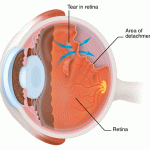 High myopia is a risk factor for retinal detachment after cataract surgery. An exact number for this risk is unavailable. Studies give conflicting rates, and the surgery techniques are not standardized so we really have no exact number, but it may average 10% using current techniques. It’s a good idea for the very nearsighted patient to see a retinal specialist prior to and after cataract surgery. While most retinal detachments can be successfully treated, there are some patients who will have permanent visual defects afterward. If your vision is really not meeting your needs, waiting longer before you have cataract surgery will not reduce the risk of retinal detachment, only postpone it. We have more informatin on retinal detachment HERE.
Epiretinal Membrane
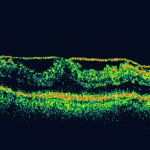 This condition is common in the age group undergoing cataract surgery, and when it is present it may result in less vision improvement after surgery than the doctor and patient expected. At MarinEyes we try very hard to identify this condition BEFORE the cataract surgery in order to counsel the patient correctly. It can be very difficult, however, to see the epiretinal membrane when it is obscured behind a cataract. MORE
Flomax®
The most important thing for our patients to know is that Flomax® may make your cataract surgery more difficult. It interferes with pupillary dilation, and makes it harder to safely remove the cataract. IF YOU TAKE OR HAVE EVER TAKEN FLOMAX, TELL YOUR CATARACT SURGEON BEFORE SURGERY! Your surgeon may take special measures at the time of surgery; please notify your surgeon and discuss this with him. Flomax® is an excellent medication for its intended purpose; with appropriate measures taken for your cataract surgery, actual complications are infrequent. MORE
Cataract after Refractive Surgery
The primary concern here is that it is extremely difficult to select the correct IOL power for your implant. At MarinEyes, we use a variety of advanced methods to try to prevent this problem, but in truth a significant number of post-refractive cataract patients will require additional surgery (laser or incisional) to get the best result. On the positive side, if your lens implant should turn out to be too weak or too strong, there are two very good options to remedy the situation: a “touch-up” laser refractive treatment (usually PRK) or surgical insertion of a corrective supplemental lens implant. These treatments are generally delayed untiol the eye has stabilized after the cataract surgery. No procedure is without risk, but these are relatively straightforward treatments. MORE